Route Performance
Route Performance gives an overview of the planned routes vs. actual. This tile on the dashboard is great for route and time management. You can search by route in the upper right corner of the page. This page displays information such as the time it took to run the route as well as what time the driver arrived at stops on the route.
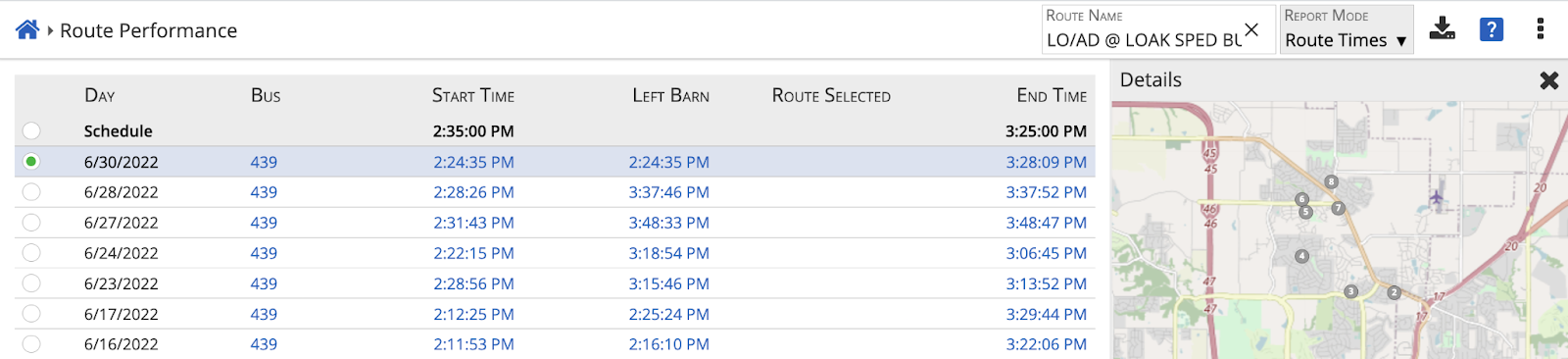
Report Mode: Route Times
Change the report mode to Route Times in the upper right hand corner to compare the scheduled start and end times of the route with the actual on a given day. Further details include the time the bus left the bus lot.
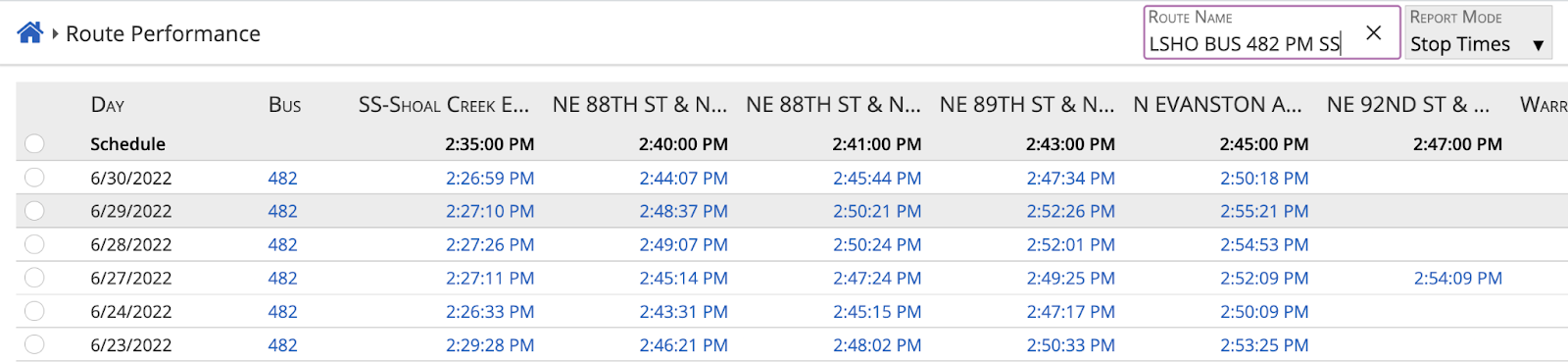
Report Mode: Stop Times
Change the report mode to Stop Times in the upper right hand corner to compare the scheduled times at stop with the actual on a given day. This is a helpful feature to better manage accuracy of scheduled stop times.
Related Articles
Route Runs
The Route Runs section will allow you to view previous routes that have been completed by your fleet. Clicking a line will expand the information for that route and display it on a map. To learn how to edit stops, see our article on editing stops.SSD Diagnostic Failure/Video Storage Performance
Explanation When you see either the SSD Diagnostic Failure alert or the Video Storage Performance alert, that means that an attendant's primary storage for video (solid state drive, or SSD) has failed one or more automated diagnostic tests. ...Routes
The Routes page, found in the Route Management section of the dashboard, shows all of your routes. Upon first opening, you will see a list of your routes: The Routes page Here you can add a new route. If you select an existing route, you can see ...Print Routes
You can print your routes directly from the dashboard. When printing your routes, you have the option to display directions, student IDs, direction icons, and more. Here's how: From the main page of the dashboard, find the Route Management section. ...Data Import
The data import page, found in the Administrative Tools section of the dashboard, shows the most recent file uploads. Files are either manually uploaded to the dashboard, sent over HTTP or SFTP connection, or sent from routing software. If your ...